Canberra Academy of Languages – News
News – this year 
Senior secondary languages raised in ACT Legislative Assembly Question Time on Tuesday, posted 25 September 2026

MLA Laura Nuttall raised questions about Indonesian language studies in ACT colleges and central delivery options for languages in the ACT during question time yesterday in the ACT Legislative Assembly.
In responding to Laura Nuttall's initial question (2:53 pm), Education Minister Rachel Stephen-Smith said that it is not yet known whether an Indonesian course will run at Lake Ginninderra College next year and that it would depend on student uptake and teacher availability. In response to Laura Nuttall's supplementary question about possible re-establishment of centrally delivered senior secondary language courses, the minister took the question on notice and said the government is continuing to consider what the next steps are in terms of language education.
The minister also took on notice a follow-up question from MLA Andrew Braddock (2:56 pm), who asked what work the Education Directorate is doing more broadly to ensure language continuity across the ACT public school system in the context of the college budget cuts. The minister also took that question on notice.
The ACT Government has 30 days to respond to a question on notice.
See the ACT Legislative Assembly's public hearings schedule page for Tuesday 22 September 2026 for more details.
Alternatively, you can navigate to last Tuesday's proceedings by going to the assembly home page, then selecting "Parliamentary business" > "Watch, read and listen" > "Video on Demand" > "Searchable videos of Assembly proceedings" > [scroll down to:] "Tuesday 22 September 2026".
Mid September update, posted 15 September 2026
Recent language related news items as of mid-September are outlined below.




- On Tuesday 8 September, the CAL Convener met with Rachel Stephen-Smith, who took over as ACT Education Minister on 27 July, to discuss central delivery options for senior secondary languages. It was an excellent opportunity to canvass possibilities at a time when the government is considering its response to the ACT Legislative Assembly Standing Committee's report on the subject. The report was published on 2 July. We anticipate the government's response early next month.
- On Thursday 10 September, the Canberra Languages Network met at the Theo Notaras Multicultural Centre. The group last met in March of this year, so about six months on from that previous meeting, it was an occasion for key stakeholders in ACT languages education to compare notes. Topics of discussion included funding and a mooted change in the funding model for community language schools; recruitment of language teachers and ways to facilitate recognition of their credentials including a new TQI specialist permit to teach category and a pathway to Masters qualifications through the Sydney Institute for Community Languages Education (SICL); central delivery of senior secondary languages and the access this can provide for student choice independent of students' home and day school postcodes; the Yarralumla Primary School bilingual program review; language data at https://www.acicis.edu.au/resources; the ANU's Languages in Australia Survey project; language teaching assistants in schools; professional learning events organised by the Modern Language Teachers' Association of the ACT; and an upcoming national conference for teachers of French to take place at ANU on 27-28 November this year.
- On Monday 14 September, a teleconference was held by the Australian Network of Government Language Schools (ANGLS). Members are schools of languages, language centres and distance education providers throughout Australia that have a key focus on languages education. The network brings together language education providers with a common agenda of providing high quality programs to school students who may not have the opportunity to study the languages of choice in their day schools or home schools. Discussion included plans for ANGLS to establish a website to complement its social media presence as a communication channel with the broader Australian community. More details to follow soon.
Languages are disappearing, and the problem is political, posted 13 August 2026

A review by Gerald Roche was posted today on The Conversation about Sophia Smith Galler's book "How to Kill a Language: Power, Resistance, and the Race to Save Our Words". Along with dramatic instances like dispossession and forced relocation, more subtle processes such as economic pressure and political indifference are examined in the book. The book differs from previous publications in that it includes a focus on the political dimensions of language loss.
YPS targeted review submissions due on Monday 24/08/2026, posted 7 August 2026, updated 14 August 2026
A notice is currently on the Yarralumla Primary School website to advise that a targeted review will assess how the curriculum is being delivered to ensure it meets the needs of all students, aligns with system requirements, and maintains quality bilingual education. YPS runs a bilingual Italian program. To provide input, submissions are due via email by COB Tuesday 25 August 2026. (This is an extension from the original deadline of 11 August.)
ACT Legislative Assembly hearings on budget provisions in relation to language courses, posted 31 July 2026
Hearings on the ACT budget for 2026-27 ("Appropriation Bill 2026-2027"), including budget provisions in relation to language courses, are in progress. In the last half hour of the session on Thursday 30 July, several questions were put to Education Directorate representatives and the new Education Minister (Rachel Stephen-Smith) about language education in ACT schools. Several of these questions were taken on notice. We would expect that a transcript will be available from the "Committee Transcripts Eleventh Assembly" page on the assembly website next week. Currently, at the time of this post on Friday 31 July, transcripts are available up to and including 24 July (last Friday).
Invitation to provide input, posted 24 July 2026

If you are an ACT student of languages, or if you have previously studied languages with CAL or CIT Sol, and wish to provide input about the response you would like to see from the government in relation to the report on senior secondary languages, please let us know with an email to cal.convener@cal.act.edu.au.
ACT Government publishes Language Education Action Plan Activity Report June 2026, posted 21 July 2026

The ACT Government has published an activity report about its Language Education Action Plan as of June 2026. A link to the report is on the LEAP home page.
Based on what is in the activity report, it appears there has been no progress in terms of responding to recommendations 7 and 8 from the inquiry by the Legislative Assembly Standing Committee on Social Policy into central provision of senior secondary language courses.
ACT Legislative Assembly Estimates soon, posted 17 July 2026, updated 23 July 2026
ACT Legislative Assembly Estimates will take place from Tuesday 21 July to Tuesday 4 August.
See the ACT Legislative Assembly's public hearings schedule page for more details.
The education discussion is scheduled from 3:30 pm on Thursday 30 July and from 1:15 pm on Tuesday 4 August 2026. According to the disclaimer on the above page, the schedule is subject to change.
Media coverage about the ACT report on languages, posted 4 July 2026, updated 12 July 2026
Media items that are known to us about the report from the ACT Legislative Assembly's Standing Committee on Social Policy’s Inquiry into ATAR language courses are listed below. More will be added as they come to light. The government has four months to respond to the committee's recommendations. Let us know if you identify any additional sources.



- Audio from CAL Convener's discussion with ABC reporter Emmy Groves on Monday 6 July is available from the link below. A couple of short segments from the discussion were included in the ABC TV evening news on that day about the languages inquiry.
- Region News Tuesday 7 July 2026 ACT Government accused of 'complacency' as public school language plan falls short
- ABC Monday evening 6 July 2026 ACT public school language education plan found 'not fit for purpose' by parliamentary committee
- CT Monday morning 6 July 2026 Govt complacency locks students out of senior language courses, inquiry finds
- Georgia Stynes, discussion with Thomas Emerson MLA (committee chair), ABC Canberra Drive, Thursday 2 July 2026 from 4:14 pm to 4:19 pm, about the report's findings and recommendations.
- Ross Solly, discussion with Elizabeth Lee, shadow minister for education ABC Canberra Breakfast program, Friday 3 July from 7:15 am, about the report and language education in the ACT (additional to the discussion mentioned below on 1 July). Following on from the interview with Elizabeth Lee, a listener called in just before 7:40 am with reflections on a high school language program and the difficulty schools face with teacher supply.
- Nicholas Fuller in the Canberra Daily, Friday 3 July 2026, ACT students face gaps in senior language courses.
Report published on Access to 11–12 ATAR language courses, posted 2 July 2026
The report from the ACT Legislative Assembly's Standing Committee on Social Policy’s Inquiry into E-Petition 077-25: Access to 11–12 ATAR language courses was published today.
See here for the report pdf. Alternatively, go to the Social Policy Committee's page on the ACT Legislative Assembly website and select the "Reports" tab on that page for the report.
We fully support the committee’s findings and recommendations. We would like to thank the committee members for the careful consideration that they have given to this important matter.
Building Asia Capability report published, posted 1 July 2026
In today's ABC Canberra Breakfast program, soon after 3 hours 12 minutes into the podcast, Ross Solly and Anna Vidot discussed the state of languages education in Australia. The discussion arose just after the publication of the House of Representatives Standing Committee on Education's Building Asia Capability report.
The report of the House of Representatives Standing Committee on Education inquiry into Building Asia Capability in Australia through the education system and beyond has been published and is available here. The decline in Asian language learning in Australian schools is highlighted in the majority report. As noted in the Coalition comments appended to the report, the decline is also evident in learning of other languages, including European languages, and Australia's national interests are not confined to a single region. The report also mentions Aboriginal languages, but does not provide any figures on participation for these.
ANGLS 2026, posted 23 June 2026

ANGLS 2026, the annual conference of the Australian Network of Government Language Schools, is in session Monday-Tuesday 22-23 June 2026.
The ANGLS Conference is an annual event that commenced in 1998. It brings together leaders from language schools throughout Australia. ANGLS Conference has been held in each of the participating states and territories over the years, including Canberra with the Education Directorate as host in 2010 and with CAL as the host and Telopea Park School as the venue in 2019.
Two key aims of ANGLS are to share achievements, priorities and progress from each of the schools and information on policy, strategy and curriculum at national and state/territory levels.
This year’s ANGLS Conference is taking place at the NSW School of Languages in Petersham. It is hosted by the NSW SoL Principal, Teresa Naso, and chaired by the President of ANGLS, SA SoL Principal, Dr Michelle Kohler.

Notes about languages inquiry hearings transcript, posted 27 May 2026
Several assertions from the languages inquiry hearings require responses. See below.
- In the session with ACT Parents, about advice the committee received that 25 per cent of out-of-area enrolments for languages were knocked back due to school capacity, the witness responded that it might be "like a one-off". First, 25 per cent of cases is not a "one-off". Secondly, those were the cases where families took the trouble to pursue an out of area option, but they are by no means all the cases where the preferred language choice is unavailable. Later in the session, the witness said they were not aware of any out-of-area applications being rejected based on subject. Given the information provided by the chair earlier in the same session, this was a surprising observation to make.
- On the issue of equity, the Parents ACT witness expressed concern about a fee for service, but did not address the equity issue of a postcode (the location of a student's home or day school) as a constraint on curriculum choice in languages.
- On the question of costs, the Parents ACT witness commented on low enrolments with CIT without addressing the reasons why those numbers increased throughout the time with CAL, but reduced dramatically in the time with CIT. For more on this, see the point below on marketing.
- In saying that they did not think $206,000 would be the true cost of running a centralised service, they provided no evidence for that judgement. The fact is that the main cost is staffing, and the estimate mentioned by the Chair was using salary figures from the government's own EBA for teachers, as published on the government's website. Also, as noted by the Chair, cost estimates (as cited by the Chair) did include other aspects such as a director of languages, an IT officer and multiple different resources.
- In a comment on another area, the witness rightly observed that it would be desirable to see more action on the government's language action plan. However, by the government's own admission, languages are not "a priority right now".
- Later in the session, the witness again questioned the costs for a centralised program, and conjectured that the $206,000 figure may be based on volunteering. As explained in the CAL submission, Fair Work specifically advised against volunteering as a basis for staffing a senior secondary languages program where there is high accountability for assessment. The cost estimates were based on published teacher salary scales.
- In the session with CIT, the question of marketing was raised. Prior to its demise, CIT Solutions had a dilemma about marketing, because soon after they became a provider for the language programs, the parent organisation (CIT) was in the news with issues about governance and the establishment of an expensive consultancy with a private contractor. CIT Solutions were hesitant about raising their public profile in that context. And when CIT took over as the program provider, they were a reluctant and distracted custodian of the programs, and there was no effective marketing. Further, they did not allow any new enrolments for 2026. That translated predictably into a rapid decline in numbers, in contrast to the yearly increases in enrolment numbers posted by CAL as the previous provider.
- In the session with the Education Directorate, the DG stated that the cost to deliver a senior secondary languages program would be significantly more than the estimate provided by CAL. This is strongly disputed. The DG mentioned staff entitlements and the requirements to deliver that span of languages (presumably referring to the six languages in the CAL estimate). The fact is that the CAL scenarios for program costs used the government's own EBA document to calculate staff salary costs. As stated in the CAL submission, the salary figures may change when the EBA is renegotiated, and the salary costs will depend on the level of teachers on the salary scale, as it does in the day schools. It was also made clear in the CAL estimates that the revenue side of the budget would depend on enrolment numbers (which in turn depends on communication with target groups) if a fee-for-service or cost recovery model is used.
- In responding to a question about a centralised language provision, the Education Directorate DG said that in a primary school setting, it would be challenging to do this. The response is not relevant to the focus of the inquiry, which is about senior secondary languages, not primary education settings. Further, the primary and high school settings were expressly kept out of CAL proposals lodged with the government, for two reasons: first, to keep the scope of provision manageable for a small jurisdiction; and secondly, because the community language schools can supplement day school programs in a meaningful way if they are well coordinated and supported, but senior secondary program provision is just not a practical option for most of the community language schools.
Languages inquiry hearings transcript on assembly website, posted 20 May 2026
The transcript of the hearings held on 28 April 2026 on access to senior secondary language courses is now available on the Legislative Assembly website. See Hansard area on the ACT Legislative Assembly website. We thank the committee secretariat and the Hansard staff for their work in preparing and posting the transcript. We will publish notes relating to some matters of significance based on the transcript in the near future.
Alternatively, navigate to the transcript via the ACT Legislative Assembly home page and select "Watch Read and Listen", then "Hansard", then choose the "committee hearings" link. At the top of the committee transcripts page, select "Eleventh Assembly", then (scrolling down) "Standing Committee on Social Policy", then (scrolling down) "Transcript" on the entry for 28 April 2026.
Article on ABC News about NSW online public school, posted 14 May 2026

ABC News published an article today about NSW online school Aurora College, which from next year will assist schools experiencing lack of staffing or resources to offer selected specialist senior subjects by providing HSC courses in virtual mode for New South Wales public school students.
Aurora College has confirmed that the courses are only for NSW government school students and that they do not run language courses. The planned NSW programs will not provide an alternative strategy for the ACT government with senior secondary languages.
Article on Region News about languages inquiry, posted 4 May 2026

Region News published an article about the ACT Legislative Assembly's languages inquiry on the weekend, quoting the Education Minister as saying language education isn't a priority right now.
That is a summation of the government's regrettable position at present on provision of a central delivery option for senior secondary language courses, but when the standing committee delivers its report, the government should engage constructively with the committee's recommendations.
There are points relating to some details in the Region report that should be noted:
- The article states that CAL offered two-hour after-school language classes. That is an incomplete representation of what we did. CAL used a hybrid delivery model, comprising two hours per week face to face and two hours equivalent set work for students to complete away from the face to face classes. CIT Solutions and CIT continued with that hybrid delivery model in 2024 and 2025, but CIT in 2026 is delivering courses face to face with students with one 3.5 hour session at their Bruce campus each week. For many students, this would exceed their capacity to sustain concentration in a single continuous classroom session.
- The article notes that CIT moved to wind up CIT Solutions in 2025 after it ran a deficit of $1.5 million in 2024. What is not made clear is that the deficit mostly was not attributable to the senior secondary language programs. In fact, through active and sustained effective communication with prospective students and their families and schools, it would have been realistic to expect the senior secondary language programs to achieve full cost recovery, funded through enrolment fees paid by families or schools (that decision was up to the school principal at each participating school).
- The point that I made about making employment as a teacher more attractive was that teachers could teach at a day school during the school day, while also teaching in the central delivery program after school hours, thereby increasing their overall involvement in language teaching. Many language teacher positions in day schools are not full-time, which means teachers are either on a reduced wage or in some cases also teaching subjects that are not their specialisation or preferred teaching areas.
- The costing that I cited ($206,000 for six teachers working for 0.2 FTE each, based on the current enterprise bargaining agreement provisions for public school teachers and a typical teacher being on a level 6 pay scale) did take into account some other cost factors in addition to salary costs. These include a coordinator on 0.1 FTE (who could undertake other teaching and coordination roles in addition, outside the language prorgram, depending on the deployment mode), administration/reception on 0.1 FTE, and information technology support on 0.1 FTE, as well as some curriculum resources and a modest web hosting provision.
- The $102,825 forecast loss cited by CIT for the 2026 program is the inevitable result of insufficient prior marketing and a decision by CIT not to accept any new enrolments. While the salary costs remain the same regardless of the average class size, the revenue is dramatically affected by any change in average class size. The costing that I prepared for 2026 shows full cost recovery based on an average class size of 12 or a total of 72 enrolled across six classes. By contrast, according to evidence provided by CIT in the hearings on 28 April, there are only nine students currently enrolled in total. No wonder CIT is forecasting a "significant" net loss this year.
Languages inquiry hearings video records on assembly website, posted 29 April 2026
Videos of yesterday's hearings on access to senior secondary language courses are now available on the Legislative Assembly website. See committee hearings searchable videos page on the ACT Legislative Assembly website.
Alternatively, navigate to the page via the ACT Legislative Assembly home page and select "Watch Read and Listen", then "Video on demand", then choose the "committee hearings" link.
Languages inquiry hearings under way today, posted Tuesday 28 April 2026
Hearings are taking place today with the inquiry by ACT Legislative Assembly's Standing Committee on Social Policy on senior secondary languages education and the need for a central delivery option to supplement programs in day schools. For details, see the committee website. Select the "Hearings and transcripts" tab.
Languages inquiry hearings to be held on Tuesday 28 April
Hearings for the ACT Legislative Assembly Standing Committee on Social Policy's inquiry about senior secondary languages will be held on Tuesday 28 April. If you are listed to appear, you should by now have heard from the committee secretariat (as of 21 April).
Languages inquiry submissions published on Legislative Assembly website, posted 20 April 2026, updated 22 April 2026
Submissions to the ACT Legislative Assembly Standing Committee on Social Policy's inquiry about senior secondary languages have now been published on the assembly website. There are 30 submissions. Look here for an update soon about hearings with the committee.
Hearings planned for the languages inquiry, posted 14 April 2026
The ACT Legislative Assembly Standing Committee on Social Policy is planning to hold hearings on Tuesday 28 April for its inquiry about language courses. Please contact the CAL Convener if you would be available to attend a panel session for parents and students or alumni between 1 pm and 1:45 pm on that day (TBC, not yet confirmed).
Closing date extended for submissions to assembly inquiry, posted 2 April 2026
The Standing Committee on Social Policy has announced it is extending the due date for submissions to its inquiry into E-Petition 077-25: Access to 11–12 ATAR language courses in 2026. The deadline for submissions is now Friday, 10 April 2026. The Committee is particularly interested in hearing from students and community members about their experience of the changed language offerings.
Future of centrally delivered senior secondary language courses in the ACT, posted 2 April 2026
As noted in the post of 16 February below, the CAL Convener canvassed the possibility with another organisation of program delivery for BSSS accredited senior secondary language courses. The governing committee of the Community Language Schools Association concluded that the CLSA is not appropriately placed in terms of its charter, its organisational structure and its facilities to conduct such programs, particularly given the curriculum and assessment requirements for senior secondary course delivery. Furthermore, in other Australian education jurisdiction where Schools of Languages exist, they are government-run.
Can an Arts degree change the world, posted 5 March 2026
Can an Arts degree change the world: segment on the appalling state of languages in universities today from 37:44 in this podcast on the ABC website.
Access to 11-12 ATAR language courses petition petition triggers assembly inquiry, posted 4 March, updated 7 March 2026
Mr Thomas Emerson, Chair of the ACT Legislative Assembly's Standing Committee on Social Policy, advised us today that the Committee has resolved to undertake an inquiry into the petition relating to access to 11-12 ATAR language courses. Submissions to the inquiry are open, until 5 pm on 2 April 2026. See the committee's page on the ACT Legislative Assembly website.
Please contact either us or the office of Thomas Emerson MLA if you would like to provide input for the inquiry. For more information about the petition and the need for a provider for central delivery of senior secondary language courses, see the posts below.
Learning languages at no cost via Libraries ACT, posted 25 February 2026

Discover Languages with Libraries ACT! With access free of charge via Libaries ACT to Mango Languages, learn English in your native language or explore 70+ world languages!
Future of centrally delivered senior secondary language courses in the ACT, posted 16 February 2026
Further to the information below, during the summer break, the CAL Convener canvassed the possibility with UC and ANU of taking up a provider role in senior secondary languages to supplement course delivery in day schools. They have advised that, while they see the need for a provider, as organisations with a focus on tertiary education, they could not take up such a role. The matter has been taken up with another possible provider. An update will be posted here when we have their response.
Future of centrally delivered senior secondary language courses in the ACT, posted 15 January 2026
We are continuing to investigate provider options for centrally delivered senior secondary language courses. The ACT Government and CIT are not prepared to commit to ongoing program delivery for these courses. For students whose day schools are not able to offer the courses in the languages they wish to learn, it is vital that a capable and trustworthy provider be found.
Several options have been canvassed. We are currently focusing on two of these options. The matter is time critical for the current Year 11 cohort in the ACT, for whom commencement by March of this year is required if they are to achieve a language major. We hope to provide more details soon.
News – Last year 
Future of centrally delivered senior secondary language courses in the ACT, posted 14 December 2025
As advised in a post below, the ACT government confirmed in the Legislative Assembly on 4 December that it has no plans to facilitate continuation of centrally delivered senior secondary language courses.
We would like to confer with interested parties on possible next steps. We are considering which organisations may have the capacity and be prepared to make the commitment to take on program delivery into the future. Any input would be welcome.
Meeting with David Pocock, posted 12 December 2025
Thanks to David Pocock for the opportunity to meet with him at his mobile office today. He has an excellent understanding of the range of issues facing languages education, both in the ACT and nationally. We look forward to conferring with Senator Pocock and his team to address these issues.

Follow-up article from Region news portal, posted 8 December 2025
This article begins with the appropriate observation "If ever there was a place where language education would be supported, you’d think it would be the national capital".
Region news portal publishes article about senior secondary languages, posted 6 December 2025
Region news website published an article yesterday by Ian Bushnell about senior secondary languages in the ACT and the events that took place on Thursday: CIT Solutions' demise a blow to language students but Berry won't replicate program.
Government still has no plans for central delivery of senior secondary language courses, posted 5 December 2025
The final sitting of the assembly was held this week from Tuesday to Thursday 2-4 December. Most members of the assembly (but not the cabinet) were in consensus on the need to progress the issue and get something done. Despite the high level of public support, the Education Minister reiterated that the government has no plans to facilitate continuation of centrally delivered senior secondary language courses.
The minister in responding to the matter in the assembly yesterday rightly observed that I would be disappointed by the government's response. We will now confer with interested parties on possible next steps. Any input would be welcome.
Petition had 582 signatures on closing, posted 3 December 2025
The languages petition on the ACT Legislative Assembly website had 582 signatures on closing last night. The petition calls on the ACT Government to ensure that there is provision for students going into Year 11 next year to study their language of choice if it is not offered at their day school. More information here soon on what's next.
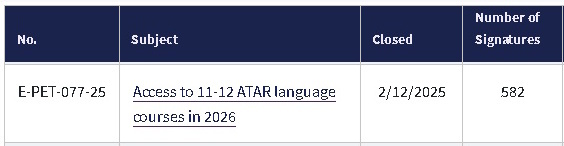
Petition has 560 signatures today, posted 30 November 2025
The languages petition on the ACT Legislative Assembly website has received 560 signatures as of this evening. The petition calls on the ACT Government to ensure that there is provision for students going into Year 11 next year to study their language of choice if it is not offered at their day school. To add your voice and advocate for action on this, please visit https://epetitions.parliament.act.gov.au/details/e-pet-077-25.
Petition passes 500 signatures today, posted 24 November 2025
The languages petition on the ACT Legislative Assembly website has received 502 signatures as of mid-afternoon today. Titled "Access to 11-12 ATAR language courses in 2026", it calls on the ACT Government to replicate the Year 11-12 ATAR language courses in 2026 within the ACT Education Directorate, starting with year 11 students in February 2026, so all ACT students can continue studying their chosen language at the ATAR level.

CAL Facebook has 300 followers, posted 24 November 2025
We have reached a significant milestone on the CAL Facebook page today, with 300 followers. Thank you to all of you who are contributing your voices to the causes of language learning and enhancing intercultural understanding.
New evidence on the benefits of multilingualism, posted 21 November 2025

Good news for multilinguals: a new study with more than 80,000 participants from 27 countries in Europe has underscored the protective role of multilingualism and its broad applicability for global health initiatives.
See the original article here: www.nature.com/articles/s43587-025-01000-2.
See also here an article about the research project from the Trinity College Dublin website, with comments from the senior author and lead authors.
Government response on provision of centrally delivered language courses, posted 18 November 2025
In a letter received yesterday, the ACT Education Minister advised that there are no plans for the Education Directorate to provide a centralised language program in 2026.
The alternative option for affected students of out of area enrolment, mentioned in the minister’s letter, is entirely unsatisfactory, and the languages education action plan, cited in the next paragraph of the letter, also does not satisfactorily address the issues we have been raising.
Meanwhile, at the time of writing on Tuesday morning, 18 November, we have 438 signatures on the online petition about the senior secondary languages matter. You can access the petition page at https://epetitions.parliament.act.gov.au/details/e-pet-077-25 if you would like to participate in advocacy about the need for central delivery senior secondary languages after school hours to complement existing day school programs.
Senior secondary languages "not a priority" for CIT, posted 14 November 2025
In today's ABC Canberra Breakfast program, at about 8:53 am (or 3:23:45 into the podcast), Ross Solly followed up previous discussions about senior secondary language programs with a question to Minister Michael Pettersson. Among other roles, he is Minister for Skills, Training and Industrial Relations and has some oversight of CIT.
Ross Solly: What about the language courses? Do you have an update on those for us Michael Pettersson, because that was a hot-button issue. A lot of people were very upset with what was happening there. Have you got an update for us in that area?
Michael Pettersson: I don't have a conclusive update that will I think resolve everyone's concerns. I can provide an update on behalf of CIT. CIT will continue to provide that language instruction for [current] Year 11 students going into next year. That's the commitment they've made to the cohort they've already got. We're still waiting on a decision from Education as to what they see as the future of that offering; but for the cohort currently enrolled, CIT is going to follow through your needs for your time.
Observation: In launching its own program from the start of 2026, ACT Education should move the cohort that is currently enrolled with CIT (who will be in Year 12 next year) into the program, alongside next year's Year 11 cohort. That would be much more cost effective and better for the ongoing viability of the delivery model.
Meanwhile, as of Friday evening, the petition about future provision of senior secondary language courses has now recorded more than 400 signatures. We would encourage you to go to the petition page if you would like to add your voice to this cause.

Submission sent to members of the ACT Legislative Assembly, posted 6 November 2025
A submission on the need for centrally run senior secondary language courses to supplement day school programs has been sent to each MLA this week, about the need for centrally run senior secondary language courses to supplement day school programs. To view a copy of the submission, see here for the link.
Benefits of language learning, posted 4 November 2025
"New language, new life" ...
Presenter Saskia Mabin held a discussion about languages and linguistics on ABC Canberra Mornings last Friday with author and ANU academic Professor Nicholas Evans who highlighted that we live in one of the most linguistically diverse parts of the world and who quoted a Czech writer's adage "New language, new life". He also said that any age is a good age to start learning a language. His latest book "Words of Wonder" has been translated into multiple languages. The podcast is at https://www.abc.net.au/.../canberra.../mornings/105940702. The discussion commences 44 minutes into the podcast.
Petition launched with ACT Legislative Assembly, posted 30 October 2025,updated 6 November 2025
A petition has been launched for access to 11-12 ATAR language courses in 2026, to replicate the Year 11-12 ATAR language courses in 2026 within the ACT Education Directorate, starting with year 11 students in February 2026, so that ACT students whose day schools do not offer their chosen language can undertake courses after school hours and continue studying their chosen language at the ATAR level.
To sign the petition, please follow this link, or use the QR code below.


Senior secondary languages "not a priority" for CIT, posted 29 October 2025
In yesterday's ABC Canberra Breakfast program, just before the 9 o'clock news, Ross Solly raised a question with CIT CEO, Dr Margot McNeill, about CIT's intentions with senior secondary languages.
Ross Solly: I know there's been a lot of talk about the CIT delivering language courses for Year 11 and 12. Any change there in accepting enrolments for secondary language courses?
Margot McNeill: That's really a discussion we've had in the context of the broader Education Directorate discussions, because CIT primarily delivers post-school qualifications, so that's where we're in discussions. We know that we're continuing to honour the obligations with students who are already enrolled, but those conversations are happening to see what we'll do in the future. It hasn't been the priority of CIT. Again, it comes back to priorities.
Insight: the ACT government needs to listen to what CIT is saying and bring these programs in-house with Education Directorate.
Advocating about senior secondary languages, posted Friday 17 October 2025, updated Tuesday 21 October 2025
A new flier about advocacy for centrally delivered senior secondary language courses is now available. For details, see here.
We have received confirmation that CIT will not accept any new enrolments for senior secondary language studies. As a result, it is no longer a suitable custodian of the ongoing strategy for central delivery of Year 11-12 language courses in the ACT. For continuing program provision into the future, the only remaining option now is for the government to bring programs in-house with the ACT Education Directorate. More action is about to commence so that the implications can be highlighted, to ensure that those issues are addressed by the government. If you would like additional information, please send an email to the CAL Convener.
Acting Chief Minister Talkback about senior secondary languages, Friday 10 October 2025
Senior secondary languages were featured during Ross Solly's ABC Canberra Breakfast program with Acting Chief Minister Talkback on Friday 10 October 2025. To hear the discussion, go to https://www.abc.net.au/listen/programs/canberra-breakfast/breakfast/105853186. This discussion about languages starts at 3:09:30 in last Friday's Canberra Breakfast podcast.
Essentially, the current status of the story is that there is,as yet, no information available to schools and to the public about plans for centrally delivered senior secondary language courses for new cohorts from next year onwards. It is very late in the year for questions about this to remain unanswered. The time for clarity about such matters is in March to April each year, before the college enrolment process commences in the ACT.
Second ABC story about senior secondary languages, posted 9 October 2025
There was a second discussion about languages education opportunities for ACT students in Years 11 and 12 on ABC Radio Canberra Drive program with Alice Matthews this afternoon, this time with the former convener of the Canberra Academy of Languages. To hear the conversation, go to https://www.abc.net.au/listen/programs/canberra-drive/drive/105851560. This second discussion about languages starts at 2:19:00 in the podcast.
ABC story about senior secondary languages, posted 8 October 2025
ABC Radio Canberra Drive program with Alice Matthews yesterday afternoon discussed emerging concerns about language learning options in the ACT for current Year 10 students who are going into Year 11 next year. To hear the conversation, go to https://www.abc.net.au/listen/programs/canberra-drive/drive/105842096. The discussion about languages starts at 2:15:25 in the podcast.
We anticipate that a story will also be published in The Canberra Times in coming days.
Senior secondary languages discussion, posted 1 October 2025
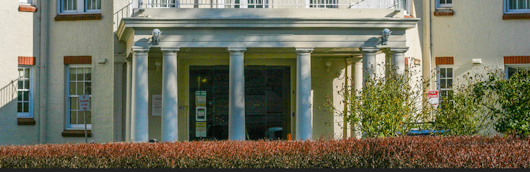
There will be an opportunity from 5 pm to 6 pm on Thursday 9 October 2025 for stakeholders including current and prospective students, and their families, to discuss senior secondary languages in the ACT..
The focus of the discussion will be centrally delivered provision of senior secondary language courses in Canberra. The venue will be the Limestone Room at Mercure Hotel, Corner of Ainslie Avenue and Limestone Avenue, Braddon. We would like to compare notes on what is known by that time about plans for 2026 and beyond, and what are the advocacy options for stakeholders.
The venue has limited seating capacity, so interested participants are asked to register interest by emailing cal.convener@cal.act.edu.au.
Decision from CIT may be announced in near future, posted 19 September 2025
We understand a meeting between representatives from CIT and ACT Education Directorate is set for the last day of Term 3. A decision about arrangements for course delivery in 2026 and later years may be announced after that meeting.
During the spring school break, we plan to be available to discuss the situation with students and families, who are among the key stakeholders who will be affected by the decision. We will post more information here about the date and time. The planned venue is the Limestone Room at Mercure, subject to availability once we have the relevant information from the anticipated CIT announcement.
For any stakeholders with enquiries in the meantime, please email cal.convener@cal.act.edu.au.
No commitment in QON response about programs in 2026 and future years, posted 21 July 2025
In a response on 14 July to a question on notice from Thomas Emerson MLA, Minister Michael Pettersson referred to ongoing consultation and provided no timeframe for resolution about the provision of centrally delivered senior secondary language courses in 2026 and future years.
Senior secondary schools are now preparing for their subject selection processes where students will choose their courses for 2026. The future provider – whether that provider sits with CIT or with Education Directorate – will require clarity about this imminently, to frame a meaningful offering for next year and future years, and to communicate that offering effectively to stakeholders including students, families and day schools.
Confirmation of CIT plans for remainder of 2025, posted 18 June 2025
CIT confirmed on 17 June that from next term, the Canberra Institute of Technology (CIT) will take over delivery of language education for all current students completing their senior secondary certificate in 2025.
Two key questions remain about plans for senior secondary language programs in the ACT:
- Will programs continue with CIT next year? If not, what provision can be put in place for current Year 11 students who need a study pathway outside their day schools to complete their language studies in 2026?
- What ongoing provision can be put in place for provision of a central delivery pathway for senior secondary language programs from 2027, to provide a fair and equitable avenue for students to undertake language courses that are not available in their day schools? The ACT would be an outlier among Australian educational jurisdictions in not having such provision, if the programs were to cease.
For more about advocacy on this see here.
If you would like additional information, please send an email to the CAL Convener.
Appointment of CIT CEO, posted 5 June 2025
A new chief executive has been appointed for the Canberra Institute of Technology (CIT). Dr Margot McNeill was formerly a NSW TAFE executive. CIT board chair, Kate Lundy, announced the appointment on 4 June.
Future of courses in senior secondary languages, posted 1 June 2025
On 17 April this year (2025), it was reported in The Canberra Times that CIT had decided to transition the commercial business of its subsidiary, CIT Solutions, into CIT and wind up the company. Some programs would be transferred to the parent organisation, Canberra Institute of Technology (CIT), while other programs would be discontinued.

At the time of this post, at the end of May 2025, there has been no announcement to the community by CIT about its intentions relating to senior secondary language courses currently delivered by CIT Solutions. It is vital for stakeholders, including students, families, teachers and day schools, to have clarity on continuity for these centrally delivered language programs.
If you believe it is important to ensure that centrally delivered senior secondary language courses continue to be available after school hours into the future in the ACT to supplement language courses available in the day schools, you can contact the CIT's governing body by emailing CIT Board. For further developments, see the more recent posts above.
News – Previous years 
- CAL News Archive 2023
- CAL News Archive 2022
- CAL News Archive 2021
- CAL News Archive 2020
- CAL News Archive 2019
- CAL News Archive 2018
- CAL News Archive 2017
- CAL News Archive 2016
Links 
- CAL Convener (cal.convener@cal.act.edu.au)
- Resources for language learners
- National Languages Plan and Strategy, AFMLTA (Australian Federation of Modern Language Teachers’ Associations), 2024
- ACT BSSS Certification Data
- Senior Secondary Languages Education Research Project: Final report 2014, Dr Michelle Kohler et al
- Learning a language helps students better understand others in an increasingly diverse Australia (2023 article on ABC website)
- Second languages and Australian schooling (Lo Bianco 2009)
 See CAL on Facebook
 See CAL on Instagram
Last updated 
© Canberra Academy of Languages, designed and maintained by Desktop Utilities

Expanding opportunities for language learning
in the Canberra region